


| Class 1: Explosives | |
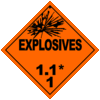 | Class 1.1: Substances and Articles Which Have a Mass Explosion Hazard |
| Includes explosives that can cause a mass explosion. In the event of an explosion, it affects almost the entire load. | |
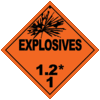 | Class 1.2: Substances and Articles Which Have a Projection Hazard but Not a Mass Explosion Hazard |
| Includes explosives that present a projection hazard but do not cause a mass explosion. | |
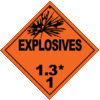 | Class 1.3: Flammable Explosives |
| Includes explosives that present a fire hazard, with a low explosion intensity and a minor risk of projection, but do not cause a mass explosion. | |
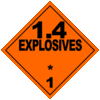 | Class 1.4: Substances and Articles Which Present No Significant Hazard |
| Includes explosives with a minor explosion risk, whose effects are limited to the package and do not cause an external explosion or fire. | |
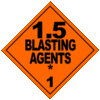 | Class 1.5: Very Insensitive Substances Which Have a Mass Explosion Hazard |
| Includes very insensitive explosives that are difficult to detonate but may cause a mass explosion. | |
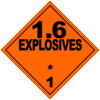 | Class 1.6: Extremely Insensitive Articles Which Do Not Have a Mass Explosion Hazard |
| Includes extremely insensitive explosives that are very difficult to detonate and do not present a mass explosion hazard. | |
| Class 2: Gases | |
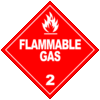 | Class 2.1: Flammable Gases |
| Substances that are gaseous at 20°C (68°F) and 101.3 kPa (14.7 psi), with a boiling point of 20°C (68°F) or below under that pressure. These substances are flammable when mixed with air at 13% or less by volume, or they have a flammable range of at least 12% with air at 101.3 kPa (14.7 psi), regardless of the lower flammable limit. | |
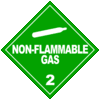 | Class 2.2: Non-Flammable, Non-Toxic Gases |
| This class includes compressed gases, liquefied gases, refrigerated liquefied gases, gases dissolved in a solution, and oxidizing gases. Non-flammable, non-toxic gases are those that are not classified under Classes 2.1 or 2.3 and have a pressure of 280 kPa (40.6 psia) at 20°C (68°F). | |
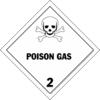 | Class 2.3: Toxic Gases |
| Toxic gases are substances known to be harmful to human health and pose a health risk during transportation. They are gases at temperatures of 20°C or below and at a pressure of 101.3 kPa (with a boiling point of 20°C or lower under this pressure). Even if their harmful effects on humans are not fully proven, they are substances that have an LC50 value of 5000 ml/m³ or lower based on tests conducted on animals. | |
| Class 3: Flammable Liquids | |
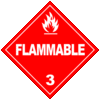 | Flammable liquids are substances with a flash point not exceeding 60.5°C (141°F), or liquids that are transported at elevated temperatures with a flash point of 37.8°C (100°F) or above. |
| Class 4: Flammable Solids | |
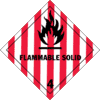 | Class 4.1: Flammable Solids |
| Flammable solids are substances that are readily combustible in their existing state. These materials can ignite through friction and have a burning rate greater than 2.2 mm (0.087 inch) per second. This class also includes ignitable metal powders that react completely within 10 minutes or less. Substances that are thermally unstable, capable of undergoing strong exothermic reactions without the presence of air, and self-reactive materials are also included in this category. Additionally, explosives that have been desensitized or specifically classified under this category by the manufacturer are included. | |
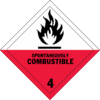 | Class 4.2: Substances Liable to Spontaneous Combustion |
| Substances that ignite spontaneously are pyrophoric materials. These are substances that ignite within five minutes of contact with air or heat up upon contact with air without requiring any external energy source. | |
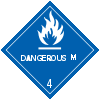 | Class 4.3: Substances Which Emit Flammable Gases in Contact with Water |
| These substances emit flammable or toxic gases when in contact with water. The level of hazard is defined as the release of more than 1 liter of gas per kilogram of substance per hour. | |
| Class 5: Oxidizing Substances and Organic Peroxides | |
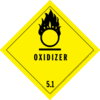 | Class 5.1: Oxidizing Agents |
| These substances release oxygen and thereby cause or enhance the combustion of other materials. | |
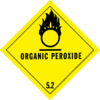 | Class 5.2: Organic Peroxides |
| Organic peroxides (Class 5.2) are substances that contain oxygen in the form of an O–O structure. They can be considered derivatives of hydrogen peroxide, formed by replacing one or more hydrogen atoms in hydrogen peroxide with organic radicals. | |
| Class 6: Toxic and Infectious Substances | |
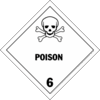 | Class 6.1: Toxic Substances |
| Substances known to cause harm to humans during transportation are classified as toxic substances. Additionally, substances identified as toxic through tests conducted on animals are also considered hazardous to humans and are included in this category. | |
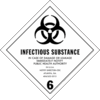 | Class 6.2: Infectious Substances |
| Substances containing infectious agents are those known or suspected to carry pathogens. Pathogens are microorganisms (such as bacteria, viruses, fungi, etc.) or other agents that can cause disease in humans or animals. | |
| Class 7: Radioactive Materials | |
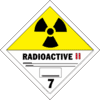 | Radioactive |
| Substances bearing the Yellow RADIOACTIVE III (LSA-III) label. Even if some radioactive materials do not carry this specific label, they must display appropriate signage indicating radioactivity. | |
| Class 8: Corrosive Substances | |
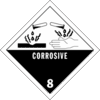 | Corrosive |
| These are substances that, upon contact for a certain period, cause corrosion or thinning of human skin. Substances that have a corrosive effect on steel and aluminum are also included in this class. | |
| Class 9: Miscellaneous Dangerous Substances | |
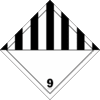 | Miscellaneous Dangerous Substances |
| Substances that pose a hazard during transportation but do not fall under any of the defined classes are included in this category. This class includes the following:
| |